



Oterloo appears as a watermark transcription in an auction catalogue for a Polish 50-złoty treasury note dated 1794. The catalogue gives the mark as W: OTERLOO. For someone who encountered the word on its own, that entry provides a specific object, date and spelling to start from.
The auction house’s reading applies to the particular note it catalogued. The catalogue associates it with Dutch papermaker Willem Stevens van Otterloo and explains why the spelling on the note has a single “t.” The catalogue’s transcription is worth preserving when describing the object.
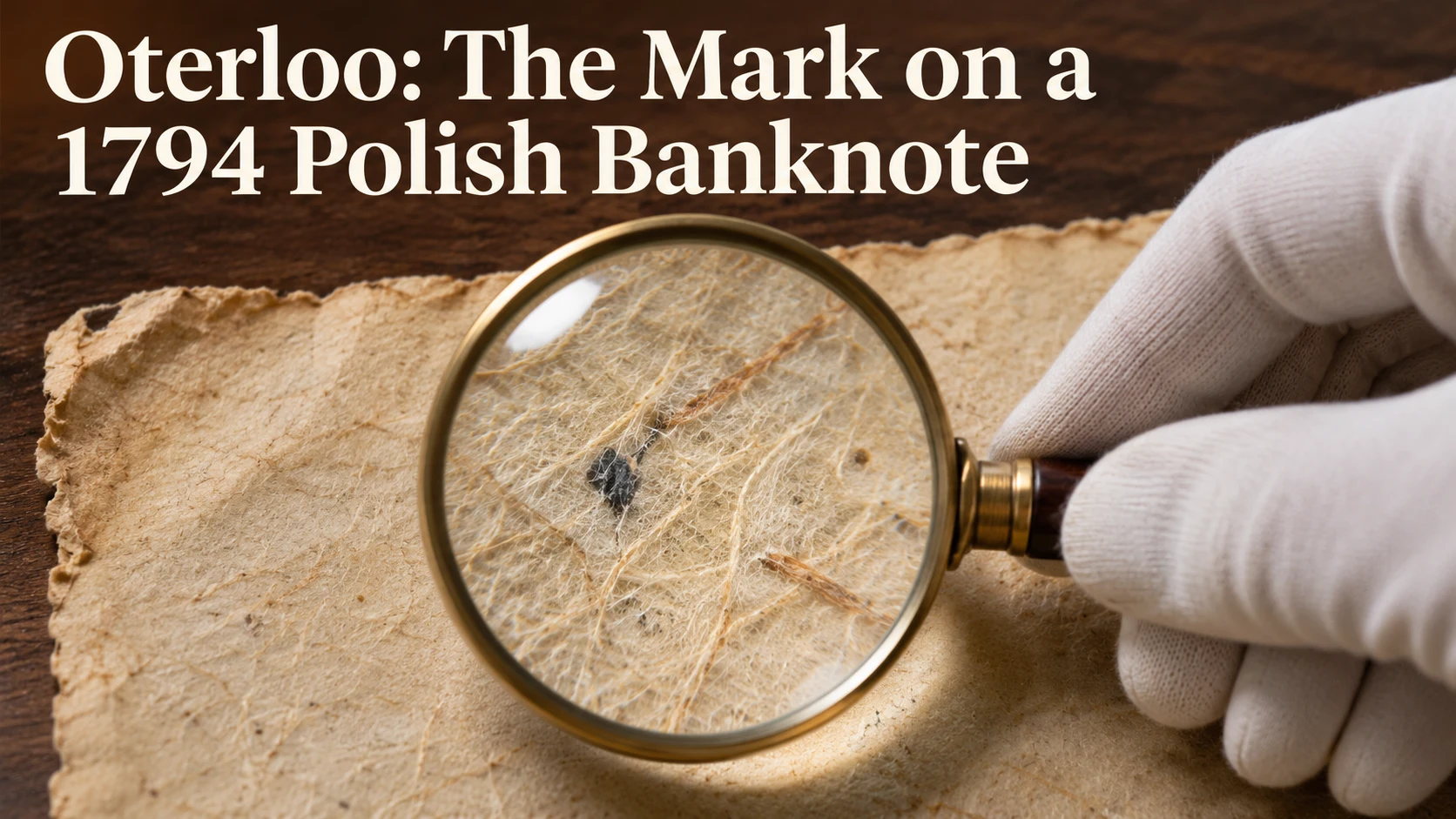
The images are editorial illustrations of paper examination. The auction catalogue contains photographs of the actual note.
The 50-złoty note from 1794
Poland’s central bank, Narodowy Bank Polski, traces the introduction of the first Polish banknotes to August 1794, during the Kościuszko Uprising. These issues included treasury notes in several denominations, among them 50 złotych. The bank describes their visual symbols and dry seals as part of the historical design.
The auction listing adds information about one example. It identifies the note as a 50-złoty treasury issue and draws particular attention to the watermark in the paper. The appearance of the same lot on another auction platform helps locate the catalogue description. Both platforms are carrying information about the same auction entry.

How a watermark differs from printed lettering
A watermark is a pattern in the paper itself. Light passing through the sheet can reveal differences that are hard to see from the surface. Printed lettering, by comparison, sits on the face of the note. A collector studying an object can compare the printed design, the seal and the paper as separate details.
That distinction helps explain the way auction listings are written. The denomination and year usually identify what was issued. A watermark can help distinguish the paper used for one surviving example. Two notes that look similar from the front can be described differently in a specialist sale if their paper or other physical details differ.
A digital picture adds another layer of uncertainty. Lighting, resolution and folds in the paper affect how readable a watermark is. A transcription by a cataloguer is useful when the photo alone is difficult to read. Where the spelling matters, keep the transcription with its attribution and describe how it was recorded.
How to read the listing without overinterpreting it
Start with the lot title and description. Confirm the denomination, date, series and auction house. Then see where the watermark appears in the entry and whether the photographs support the reading. If the listing appears on two sites, compare the auction and lot identifiers before treating them as two different notes.
The same care applies when comparing prices. A sale estimate, a starting bid and a final recorded price each answer a different question. Terms may also affect whether the displayed figure includes buyer fees. Trustify News’s AuctionZip guide covers how to read auction listings and fees. For a historic note, the original specialist catalogue is where to check the individual description.
What the spelling can establish
The auction house associates the watermark with Willem Stevens van Otterloo, a papermaker active in Velp in the Netherlands. The catalogue points to W. A. Churchill’s reference work on European watermarks, which records a form with two “t” letters. That comparison explains how a search for the exact mark can lead to a surname written differently.
The distinction is useful in a catalogue entry. Write Oterloo when giving the auction house’s transcription. Write van Otterloo when referring to the papermaker in its attribution. Keeping those forms distinct lets someone find both the lot and the reference material without silently turning a historical mark into a modern spelling.
The catalogue establishes that a specialist auction house publicly recorded the string OTERLOO on a note from the 1794 issue. When researching the word, use the exact spelling to find the entry. If you find the surname with a second “t,” check whether the reference is discussing the same watermark or the papermaker more generally.
Why paper matters to collectors
A catalogue description of currency usually starts with the information that identifies an issue. The number tells you the denomination, the year locates the issue in time, and a catalogue reference helps compare like examples. A watermark is a further observation about the surviving object. It may be important even when the banknote’s name and printed design can already be identified.
England’s, France’s and the Netherlands’ paper histories can intersect with documents printed elsewhere. Paper is a material that could be traded and carried. An attribution to a papermaker is therefore a different claim from an attribution of the banknote issue. In this case, the central bank’s history describes why the Polish notes were issued. The auction catalogue discusses who may have made the sheet used for the example it sold.
When keeping a research record, capture the lot number and the auction date alongside the watermark spelling. Catalogues can change their addresses after a sale, and an image separated from its caption can be hard to place. If a second catalogue shows a similar watermark, note whether it is a photograph of the same object or a genuinely separate example.
Frequently asked questions
Is Oterloo the name of a banknote?
It appears in the catalogue as a watermark on a note. The object itself is identified as a Polish 50-złoty treasury note dated 1794.
Where can you see a watermark?
A watermark is often easier to see with light behind the paper. A specialist catalogue may reproduce or transcribe marks that a normal front-facing photo barely shows.
Does the watermark identify a particular paper maker?
The auction house attributes the mark to Willem Stevens van Otterloo and cites watermark literature. That is the cataloguer’s attribution for this example.
When were the first Polish banknotes issued?
Narodowy Bank Polski dates their entry into circulation to August 1794, during the Kościuszko Uprising.
