


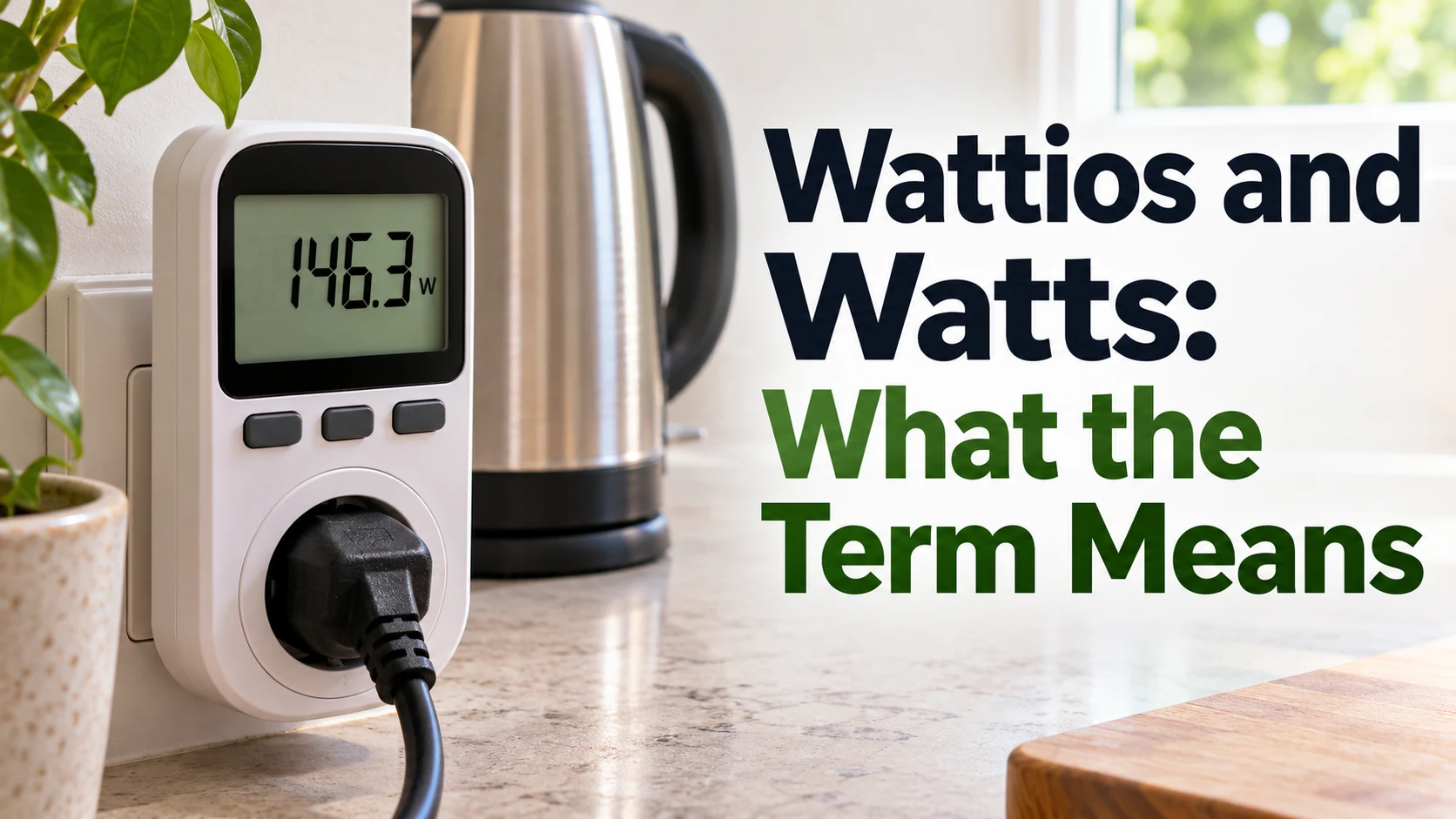
Wattios is a historical Spanish spelling associated with the watt, a unit of power. In modern Spanish, use vatio for one watt and vatios for more than one. The symbol is W. A listing that says “60 W” means sixty watts regardless of whether the rest of the label is in Spanish or English.
The Royal Spanish Academy’s historical dictionary documents the older spelling wattios in early usage of the unit. You may also see it in a brand or an informal message. Check the surrounding words. A familiar unit embedded in a business name can be a name rather than a measurement.
What a watt measures
A watt is a measure of how fast energy is used or transferred. A device drawing 100 W uses energy twice as fast as one drawing 50 W at that moment. Over the same amount of time, it would use twice as much energy. Device labels may give a rated input under particular conditions, so the rating is a starting point for estimating real use.
A kilowatt, written kW, is 1,000 watts. It is often a convenient way to express the power of larger equipment. A kilowatt-hour, written kWh, is a measure of energy over time. If a device draws 1 kW steadily for one hour, it uses 1 kWh.
How to estimate the energy a device uses
Divide the power in watts by 1,000 to convert to kilowatts, then multiply by hours. A 50 W device running for four hours at that power uses 0.2 kWh. A 1,500 W heater running for twenty minutes at full power uses 0.5 kWh. These are estimates for steady operation. A device with several power settings may draw less or more at different points.
If your goal is to estimate cost, multiply the energy estimate by the electricity rate per kWh. Fixed fees are separate. A tariff with different daytime and overnight prices requires you to use the price in effect when the equipment runs.
A product label can report electrical input or the power of an output. A charger’s advertised maximum output, for instance, describes how much power it can deliver in a supported setup. The device connected to it may draw less. The specifications matter more than the largest number printed on the box.
Why the spelling matters in a translation
For current technical writing in Spanish, vatios is the usual spelling. Keep the symbol W if a label or table already uses it. When quoting an older text, preserve its spelling and explain the modern form once. Trustify News’s guide to checking the context of unfamiliar spellings explains why a search form and a modern dictionary entry can lead you to different records.
Reading watts on common household labels
The International System of Units treats a watt as one joule per second. That definition connects the everyday label to the difference between power and energy. A machine that transfers a steady 200 joules every second is operating at 200 W. The total depends on how long it keeps operating at that rate.
Lighting packages can be an easy place to confuse different claims. An LED package may give the electricity it consumes and a separate comparison to an older bulb. Use the LED’s own wattage for energy calculations. When comparing how bright the lamps are intended to be, look for a light-output rating expressed in lumens.
For appliances that turn on and off during a cycle, a single power reading may miss most of the story. A refrigerator’s compressor can start and stop, and a washing machine can use different amounts of power while heating, spinning and waiting. The U.S. Department of Energy explains how equipment ratings and operating time contribute to estimates. If a product label gives typical energy use over a full cycle or year, that may give you a better starting point than multiplying its maximum wattage by every hour it is plugged in.
How to compare two devices fairly
Use the same task and time period for both estimates. A low-power appliance that runs constantly can use more energy than a high-power tool used for a few minutes. For example, a 100 W device running for ten hours uses 1 kWh, just as a 1,000 W device running for one hour does. Which device costs more to run depends on when it is used and how your electricity is priced.
The unit symbols can help you spot a bad comparison. W and kW refer to power. Wh and kWh refer to energy. If a chart gives the watts for one product and the kilowatt-hours for another, convert the figures to a common basis before drawing a conclusion. Keep the power and duration in your notes so you can adjust the estimate if your habits change.
Where the name and symbol come from
The Spanish historical dictionary traces the name of the unit to the English watt. The unit was named for James Watt, whose name readers often encounter in writing about steam engines. A historical spelling such as wattios helps show how the English surname and the Spanish ending appeared together before vatio became established. If you are reading an old document, the spelling can help you follow the history of the word. It does not change the amount of power it describes.
Unit names in ordinary sentences and unit symbols follow different rules. In English, write “one watt” and “two watts.” In Spanish, write un vatio and dos vatios. When writing the symbol, use a capital W with both amounts, as in 1 W and 2 W. The symbol stays the same in a plural measurement. A table or product label can therefore use the same abbreviation in both languages.
How to compare an energy label with a meter reading
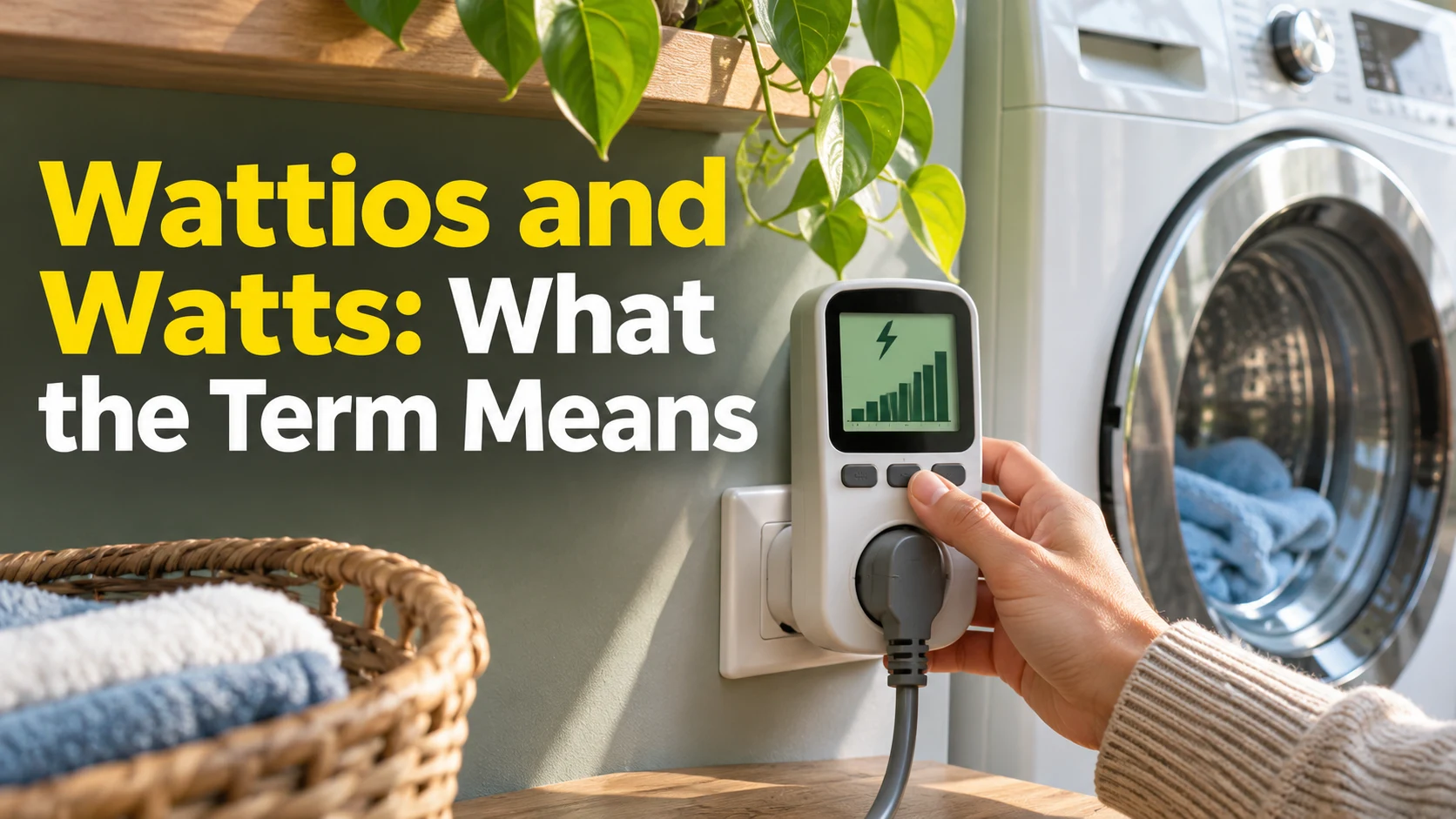
A nameplate, an energy label and a meter reading can each give you a different measurement. The nameplate tells you how a product is rated. A household electricity meter tracks use over a period. A plug-in device that displays watts tells you the power at the moment you look. If you want to know how much electricity the device used over a full day, you need either a measurement across that time or a sensible estimate of when it was actually drawing power.
Here is an example. Imagine a device rated at 300 W that uses that much power for 20 minutes out of an hour. If its use for the other 40 minutes is negligible, the active part contributes 0.1 kWh for that hour. Multiplying the 300 W rating by a whole hour would produce 0.3 kWh, three times the active-use estimate. The difference comes from what you assumed about operating time.
When you compare an energy label with a meter, use the label’s time period. If the label gives energy per cycle, compare it with one representative cycle. If it estimates typical annual use, understand that its assumptions may differ from your household’s routine. A weekly measurement can help you spot a pattern, but an appliance may work harder or run more often during a different season.
What an electricity bill can tell you about rates
A tariff can list a charge per kilowatt-hour alongside other lines. Use the energy charge when you want to estimate what running one appliance adds to the bill. Check for time-based rates if you regularly run that appliance at a specific hour. A 1 kWh task has the same energy use in the morning and at night, while the price can change if your plan charges different rates.
Keep your estimate simple enough to check later. Write down the wattage, the run time, the resulting kWh and the rate from the bill. If your measured use differs from the estimate, check each input. A calculation that correctly converts watts to kilowatts can still give the wrong household cost if it assumes the appliance runs continuously or uses a rate for a different time of day.
Frequently asked questions
Are wattios and vatios the same unit?
When used in a measurement, both point to watts. The standard modern Spanish plural is vatios.
How many watts are in 1 kW?
One kilowatt is 1,000 watts.
Is a watt the same as a watt-hour?
A watt measures power. A watt-hour measures energy, such as the amount used when a device draws one watt for one hour.
Why does my electricity bill show kWh?
It records energy used during the billing period. The watt rating on an appliance describes power at a point in time or under stated conditions.
