


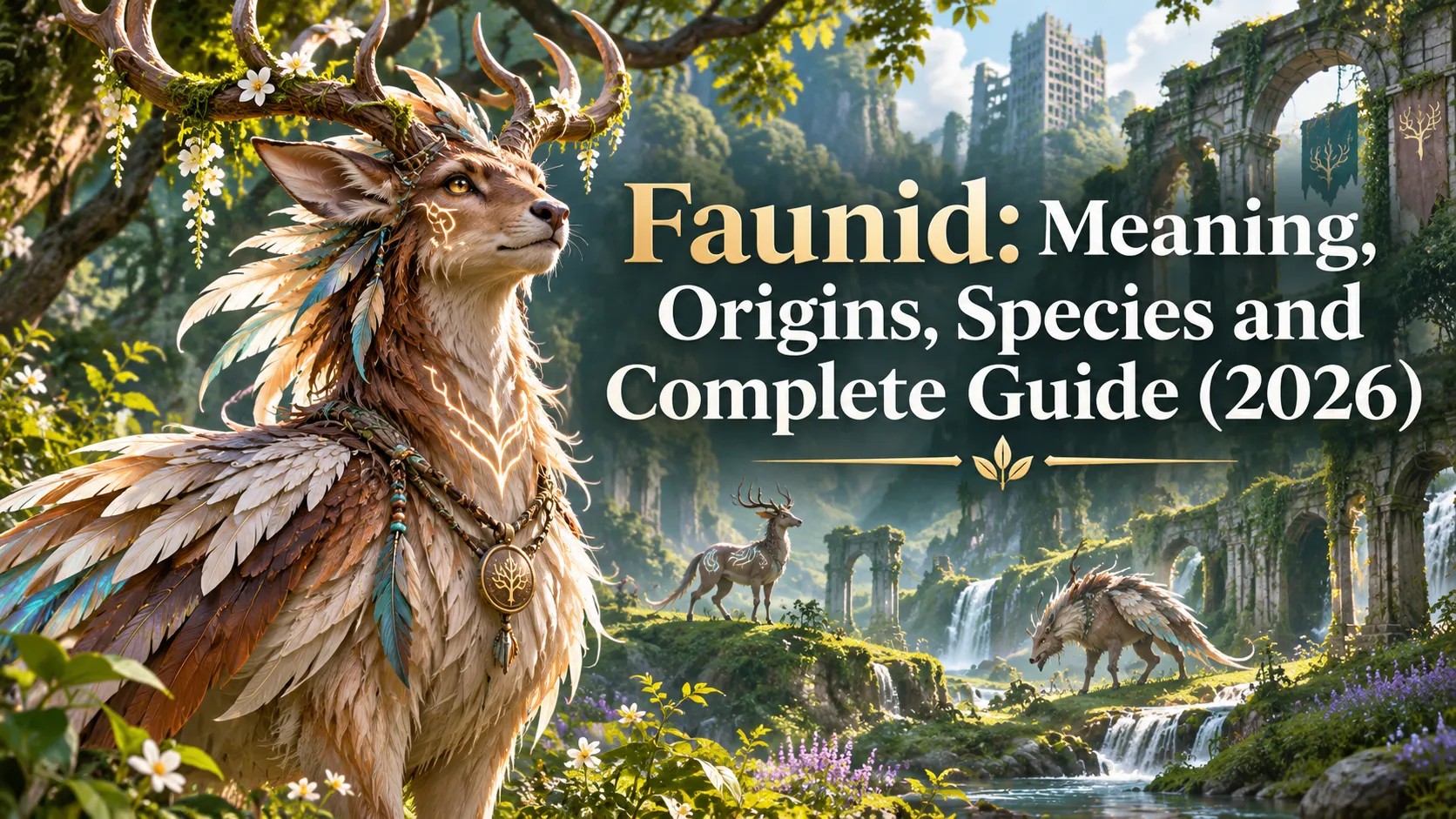
A Faunid is a fictional, intelligent, deer-like creature with feathers, created for the Faunids collaborative fantasy art and role-playing community. Faunids inhabit Atalav, a fictional world set on a post-human Earth, and exist as a closed species, meaning officially recognized characters must follow the community’s ownership and design rules.
The term is closely associated with fantasy character design, digital art, adoptable characters, and collaborative storytelling. Unlike ordinary deer or the fauns of classical mythology, Faunids belong to a specific fictional universe with established anatomy, history, societies, and supernatural elements.
As of November 2026, the Faunids project maintains an official website, character records, species guidelines, and community activities. Understanding how these elements fit together helps newcomers distinguish the fictional creatures from the community that develops and manages them.
What Is a Faunid?
A Faunid is an anthropomorphic or quadrupedal deer-inspired fantasy character distinguished by feathers and human-level intelligence. The fictional species forms the foundation of Faunids, a collaborative art role-playing game (ARPG) centered on character development and world-building.
According to the official Faunids overview, the community welcomes artists, role-players, character collectors, writers, and people interested in creating original characters within an established fantasy setting.
Although individual appearances vary considerably, recognizable elements generally include deer-inspired anatomy, feathers, and characteristics governed by the project’s species guidelines.
Key Facts About Faunids
| Feature | Details |
|---|---|
| Name | Faunid |
| Category | Fictional fantasy species |
| Main inspiration | Deer and other cervids |
| Distinctive characteristic | Feathered deer-inspired anatomy |
| Common forms | Anthropomorphic and quadrupedal |
| Fictional setting | Atalav, a post-human Earth |
| Important fictional deity | Herne |
| Community format | Collaborative art role-playing game |
| Species status | Closed species |
| Official website | Faunids.com |
| Administrator in 2026 | Jack, also known as MUTT |
| Main activities | Art, character collecting, role-playing, storytelling, and community events |
The biological classifications used within Faunids are fictional world-building terminology. They should not be confused with scientifically recognized animal species or evolutionary research.
Faunid Origins and Background
The fictional history of Faunids combines speculative evolution, environmental destruction, mythology, and the rebuilding of civilization.
Within the story, Faunids developed long after humanity’s disappearance. Their history begins with a catastrophic period known as Blissen, which devastated human civilization and dramatically changed Earth’s environment.
The surviving ecosystems gradually developed into a new world in which deer-related creatures became increasingly prominent.
The Primordial Faunids
According to the project’s species background, modern Faunids originated from Primordial Faunids, described as the result of hybridization among surviving deer populations.
Over an extended fictional evolutionary period, these ancestors adapted to different environments. Some developed increasingly upright postures, while their forelimbs became more capable of manipulating objects.
The narrative also introduces supernatural intervention. Herne, the central divine figure of the setting, granted certain proto-Faunids advanced intelligence and more functional hands and arms.
Others retained a four-legged appearance while developing comparable intelligence.
These developments explain why Faunids exist in multiple physical forms despite sharing a common fictional ancestry.
The Role of Herne
Herne occupies an important position in Faunid mythology.
Within the setting, Herne is associated with the creation and development of intelligent Faunids, their relationship with nature, and the moral expectations governing their civilizations.
Respect for the environment plays a major role in the world’s social organization. The official history describes communities that emphasize cooperation, resource stewardship, and collective responsibility.
Herne’s importance also helps explain the concept of Corruption, a supernatural transformation associated with departing from established spiritual principles.
These are elements of fictional lore rather than claims about real-world religious history.
Different Types of Faunids
Faunids are not limited to a single body shape or appearance. The official fictional taxonomy distinguishes several related forms, with different physical characteristics and roles within Atalav.
1. Anthropomorphic Faunids
Anthropomorphic Faunids, identified as Cervicheirus Cornibus, are the most human-like and versatile principal form.
They typically walk upright and possess functional hands, making it possible for them to use tools and participate in complex social activities.
Their appearances may draw inspiration from deer, elk, moose, caribou, and other cervids.
Distinctive characteristics described in the official lore include permanently retained antlers, feathered anatomy, and the capacity for certain supernatural mutations.
These characters are particularly suitable for stories involving craftsmanship, travel, social relationships, and other activities requiring human-like movement.
2. Quadrupedal Faunids
Quadrupedal Faunids, classified as Cervilania Cornibus, resemble conventional deer more closely.
Their principal difference is physical rather than intellectual. They retain four-legged anatomy but possess intelligence comparable to anthropomorphic Faunids.
According to the official descriptions, their lack of hands affects how they interact with tools and perform certain tasks.
Some are also described as capable of communicating with ordinary deer.
This form allows characters to retain a more natural animal appearance while participating in the complex fictional society.
3. Related Species in Atalav
The wider fictional setting includes additional deer-related creatures.
Merfauns, identified within the fictional taxonomy as Cerv. Aquatilis, are aquatic mammals with fish-like tails and fins. They inhabit bodies of water and cannot move on land in the same way as terrestrial Faunids.
Minodae, described as Cerv. Mimotaur, are larger, heavily built creatures associated with mountainous environments. Their anatomy and physical adaptations distinguish them from ordinary Faunid forms.
These creatures expand the world of Atalav beyond its two principal terrestrial Faunid forms.
Detailed descriptions are available in the official Faunid subspecies guide.
Physical Appearance and Characteristics
Although individual designs can vary significantly, Faunids share several defining visual and narrative characteristics.
Deer-Inspired Anatomy
Faunid designs commonly incorporate physical features associated with real cervids.
Depending on the character, these may include elongated ears, hooves, antlers, long muzzles, and body proportions inspired by specific deer species.
Some designs resemble smaller deer, while others adopt the larger proportions of elk or moose.
This diversity gives artists considerable flexibility without abandoning the overall identity of the fictional species.
Feathers and Decorative Traits
Feathers are a fundamental distinguishing feature of Faunid character design.
They may appear around the head, neck, limbs, or tail, depending on the character’s approved appearance.
Additional visual traits can include specialized tails, distinctive fur patterns, unusual body structures, and other modifications permitted by the species system.
However, not every imagined feature is automatically allowed. Official characters must follow the applicable design rules, including restrictions on certain traits and mutations.
Intelligence and Social Behavior
Faunids possess advanced intelligence regardless of whether they walk upright or on four legs.
Within the fictional setting, they form communities, develop relationships, communicate, and participate in established social structures.
They can also have individual personalities, occupations, traditions, and personal histories.
This emphasis on personality and social development distinguishes Faunids from fantasy creature designs created solely for visual appearance.
The World of Atalav
Atalav is the principal fictional setting of the Faunids universe.
It represents a world in which human civilization has disappeared and nature has reclaimed much of the planet.
The setting combines recognizable environmental features with fictional species, spiritual traditions, and an alternative history of civilization.
According to the official history of Atalav, surviving creatures gradually developed new forms of social organization following Earth’s catastrophic transformation.
Faunid Society and Culture
The official lore describes Faunid civilization as broadly comparable to certain aspects of the human Bronze Age.
Communities engage in activities such as metalworking, farming, trading, recordkeeping, and artistic production.
Occupations include artisans, guards, archivists, agricultural workers, and religious figures known as tellers.
Rather than following a modern capitalist economy, the setting emphasizes exchange, cooperative relationships, and environmental balance.
These fictional systems provide a foundation for creating believable characters with occupations, responsibilities, and connections to their communities.
Magic, Lifesource, and Corruption
Supernatural forces are another important component of Atalav.
The world’s lore includes a concept called Lifesource, which is connected to magical phenomena and transformations.
Corruption represents a significant transformation affecting certain characters. It can influence their physical appearance and their place within the broader fictional setting.
Rather than treating these changes as purely cosmetic, the community incorporates them into stories about identity, spiritual choices, and relationships.
This approach connects individual character designs to the ongoing development of the fictional universe.
What Is the Faunids Community?
Faunids is both a fictional species project and a community built around collaborative creativity.
Participants develop characters, produce illustrations, contribute stories, and interact with other members through shared activities.
The project uses an organized character registry and official rules to establish which designs are recognized within its fictional universe.
Who Created Faunids?
Faunids was originally developed and led by the creator known as Deertush, often referred to as Deer.
In August 2025, the community announced a leadership transition. Deertush stepped down after approximately eight years of managing the project.
Jack, known online as MUTT, became the new owner and administrator.
Jack had previously served in community management and administrative roles, contributing to events, character records, project organization, and world-building.
The change was publicly documented in the August 2025 Faunids newsletter.
The associated Atalav website also identifies Jack Abele as the owner of the closed species.
What Can Members Do?
The community offers several forms of creative participation.
Members can develop existing characters through illustrations and writing, take part in collaborative role-playing, enter community challenges, and participate in official character events.
The project also maintains character records that help document ownership, approved traits, and family relationships within the fictional setting.
This organization is particularly useful for a community in which characters may be transferred between owners or connected through established fictional lineages.
How to Get Your Own Faunid
Official Faunid characters are obtained through approved community processes rather than unrestricted character creation.
The official community FAQ identifies auctions, official events, custom character orders, and purchases from existing owners as recognized ways to obtain a character.
The website also maintains a masterlist of character records and a separate system for authorized make-your-own (MYO) slots.
Understanding the Closed-Species Rules
A closed species is a fictional character concept whose organizers control which designs are recognized as official members of that species.
Faunids applies this structure through guidelines governing creation, ownership, modifications, and participation.
Its published rules state that individuals cannot simply create an official Faunid independently.
However, special permissions, approved slots, and authorized events can provide opportunities for customized designs.
The distinction matters because drawing a deer-inspired fantasy creature does not automatically make it an officially registered Faunid.
How Much Does a Faunid Cost?
Faunids do not have one universal purchase price.
Costs vary according to the character, artist, acquisition method, event, and applicable commission arrangements.
For example, official 2026 auction listings included starting bids of $60 USD, while the July 2026 Summer Camp adoptable raffle offered selected characters for $40 USD each.
The community also announced a $60 USD base price for Fawns during its 2026 Fawning event.
These figures describe particular offerings, not a permanent price list. Auctions can finish above their starting prices, and custom artwork may involve different costs.
Before purchasing, buyers should review the current official sales listings and confirm the exact terms.
How to Register on Faunids.com
The official getting-started process requires an invitation key obtained from a moderator or administrator.
After receiving a key, a newcomer can register, verify their email address, and connect relevant art-community identities.
Members who already own characters can submit ownership information to have those characters linked to their accounts.
The getting-started guide also explains how to report missing character records, artwork, or lineage details.
Users should check the latest instructions before registering, as access procedures may change.
Character Ownership, Trading, and Important Rules
Purchasing a Faunid generally gives the buyer ownership rights to that character within the community’s system.
However, those rights remain subject to the applicable rules. Ownership of a character should not automatically be interpreted as an unrestricted copyright license covering every illustration or associated creative asset.
The official guidelines establish several important limitations.
- Reselling: Character resale prices are generally restricted to the original purchase price plus eligible additional artwork costs.
- Design changes: Major changes to an approved character’s basic appearance are restricted unless permitted through authorized processes.
- Character limits: Published rules allow a maximum of 30 breedable and 10 non-breedable Faunids per user.
- Ownership records: Users may need to provide evidence of ownership when transferring or claiming characters.
- Community conduct: Members must follow moderation and participation rules.
The project also uses the term Forgotten for certain characters removed from recognized participation. According to the current FAQ, restoration may be possible in some circumstances, but approval is not guaranteed.
Anyone considering a secondary-market purchase should therefore confirm the character’s status before transferring money.
The complete policies are available through the official species rules and the community handbook linked from that page.
Faunid vs. Faun: What Is the Difference?
Despite their similar names, a Faunid and a classical faun are not the same fictional creature.
A faun is a figure from Roman mythology, traditionally associated with woodlands, rural life, and the god Faunus.
Faunids, by contrast, are part of a modern collaborative fantasy project built around intelligent feathered deer.
| Feature | Faunid | Classical Faun |
|---|---|---|
| Origin | Modern fictional art community | Roman mythology |
| Main animal inspiration | Deer | Goat |
| Typical appearance | Feathered deer-like creature | Human-goat hybrid |
| Setting | Atalav | Classical mythological traditions |
| Character ownership system | Yes, for official community characters | No inherent ownership system |
| Creative context | Collaborative role-playing and character development | Mythology, literature, and art |
The Getty Research Institute’s Art & Architecture Thesaurus describes classical fauns as rural deities that were represented with goat-related features.
This distinction is useful when interpreting search results, because the similar terminology does not establish that Faunids are part of ancient Roman mythology.
Faunids in 2026: Current Developments
The Faunids project continued publishing official material and organizing community activities during 2026.
Its website includes character archives, species information, community news, sales listings, event guides, and ownership-management functions.
Several developments illustrate how the project has expanded beyond individual character collecting.
Community Events and Character Development
The 2026 calendar included Fawning activities, summer events, adoptable raffles, and opportunities for collaborative artwork.
The July 2026 Summer Camp event used a fictional storyline involving displaced aquatic creatures and ecological changes within Atalav.
Participants could complete creative activities and earn event-specific currency for associated rewards.
These activities give community members opportunities to engage with the setting without making every interaction dependent on purchasing a new character.
Corruption and Decorruption Updates
On October 4, 2026, Faunids published a preview of its Corruption event.
The announcement described changes to character transformation rules and the introduction of Decorruption, a process intended to create a distinct character category for previously corrupted Faunids.
The preview also outlined new story developments exploring spiritual identity, magic, and changing attitudes toward corrupted characters.
The announcement was explicitly a preview, so it should not be treated as confirmation that every proposed feature had already launched.
Readers interested in the implementation should consult the October 2026 event announcement and subsequent official updates.
Is Faunids.com Legitimate and Safe to Use?
Faunids.com is an identifiable community website with published rules, named administrators, character records, and a documented history of community events.
Its official documentation provides information about ownership, participation, artist commissions, and character transfers.
These are useful transparency indicators, but they are not the same as an independent security audit or a guarantee that every transaction will be problem-free.
The available public information does not establish that all participating sellers have been independently verified or that every possible dispute will be resolved in a buyer’s favor.
Anyone planning to spend money should take reasonable precautions.
Confirm that a character appears in the official masterlist, verify the seller’s authority to transfer it, review applicable resale restrictions, and retain records of communication and payment.
It is also sensible to use payment methods with suitable buyer protections and avoid unsolicited links requesting account credentials.
The most important consideration is that Faunids operates as a rule-governed creative community. Buyers should understand the character and participation rights they are receiving before making a purchase.
Frequently Asked Questions About Faunid
What does Faunid mean?
Faunid refers to a fictional, intelligent, feathered deer-like creature belonging to the Faunids fantasy universe. The term is most commonly associated with the project’s original characters, artwork, and collaborative role-playing activities.
Are Faunids real animals?
No. Faunids are fictional creatures, not scientifically recognized animals. Their anatomy and evolutionary history are part of a fantasy setting, although their visual designs draw inspiration from real deer species.
Can anyone create a Faunid?
Anyone can explore deer-inspired character concepts, but creating an officially recognized Faunid requires following the community’s rules. Approved custom commissions, official events, and authorized MYO opportunities are among the available pathways.
Where can I buy a Faunid?
Faunids can be obtained through official auctions, eligible community events, approved custom orders, or transfers from existing owners. The official website and community Discord provide information about recognized opportunities.
Who owns the Faunids species?
As of 2026, Jack Abele, known within the community as MUTT or Jack, is identified as the project’s owner and administrator. The previous leader, Deertush, announced the transfer of responsibility in August 2025.
Is Faunid the same as a mythical faun?
No. A classical faun is a goat-associated woodland being from Roman mythology. A Faunid is a modern fictional deer-inspired character created within a separate fantasy art community.
Also Read: AniKoto: Anime Streaming, Features, Safety and Alternatives

1 Comment
Pingback: Zelanski: Meaning, Origin, and Zelenskyy Connection