


The Froggatt Nielsen mechanism is a proposed explanation for a stubborn puzzle in particle physics: why quarks and other charged fermions, which share many of the same properties, can have dramatically different masses. It uses a flavor symmetry to make some interactions with the Higgs naturally weaker than others.
The central idea is that a small number can produce a wide range of values when it is raised to different powers. The mechanism gives those powers a physical meaning. The differences come from charges assigned to particles under a proposed symmetry. A model then uses those assignments to organize the masses and, in many cases, the way quarks mix when they participate in the weak interaction.
What problem does the Froggatt Nielsen mechanism address?
The Standard Model describes six flavors of quarks. Up and down quarks help make the protons and neutrons in ordinary matter. The charm, strange, top and bottom quarks carry corresponding types of charge but have different masses. The top quark is much heavier than the up quark, even though the two share the same electric charge.
After electroweak symmetry breaking, fermion masses depend on the strengths of their interactions with the Higgs field. Physicists call these strengths Yukawa couplings. Measuring particle masses places constraints on the couplings, and the Standard Model accommodates a wide range of values. It leaves the pattern of those input values unexplained. A flavor model asks what underlying rule might generate such a pattern.
The puzzle concerns more than the order of the particles from lightest to heaviest. Several masses and mixing parameters differ by sizable factors. If the numbers are independent inputs, the theory can account for them by fitting those inputs. If a symmetry relates them, researchers can ask whether fewer structural choices account for several patterns at once.
How a flavor symmetry changes the allowed interactions
In a simple Froggatt Nielsen model, particles receive charges under an additional symmetry. The word charge here refers to a property in the proposed model, distinct from electric charge. The model can assign different charges to left-handed and right-handed fields. For a coupling to respect the symmetry, the charges of the fields must combine appropriately.
Some Higgs interactions can satisfy that rule directly. Others require one or more insertions of another field, often called a flavon. Its charge makes up the difference, like the final term in a sum. When the flavon acquires a nonzero value in the vacuum, it breaks the flavor symmetry. The formerly forbidden direct interaction can then appear at low energies in a suppressed form.
Many models express the suppression through a ratio called epsilon. It compares the scale set by the flavon with a higher scale associated with new physics. When that ratio is smaller than one, needing more insertions produces a smaller coupling. The charges pick the number of insertions, and the scale ratio sets how severe the suppression is.
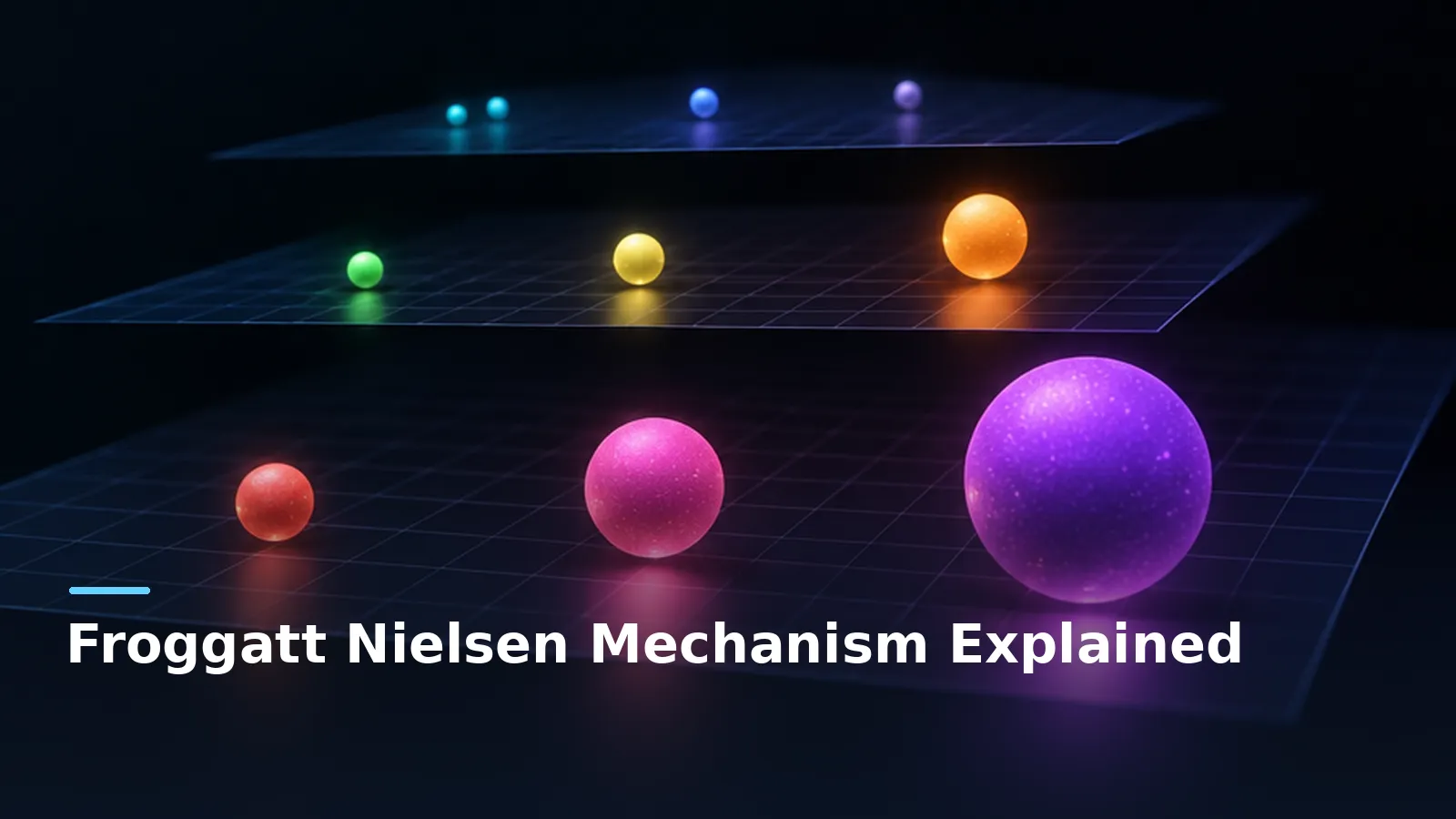
A numerical example without the algebra
Suppose the ratio is 0.2. An interaction that needs no insertions receives no suppression from this rule. One insertion multiplies its coefficient by 0.2, two give 0.04, and three give 0.008. Five insertions give 0.00032. A modest difference in the required number of insertions can therefore account for a substantial difference between the effective couplings.
These numbers illustrate the mechanism. They do not assign masses to named particles. A model also contains coefficients whose exact values may be unknown. Researchers typically take these coefficients to be of order one, meaning their sizes are ordinary compared with the large hierarchy the powers are supposed to explain. The model has more explanatory power when it reproduces the observed pattern without tuning those coefficients to extreme values.
The same example shows why agreement at the level of broad scales can still be meaningful. Two choices of otherwise reasonable coefficients might change a prediction by a factor of two. Two extra powers of 0.2 change it by a factor of 25. If the broad hierarchy persists across reasonable coefficient choices, the charge assignments are doing meaningful work.
How quark mixing enters the picture
The Higgs interactions for the up-type quarks and down-type quarks are described by separate matrices. Each matrix contains entries for several combinations of left-handed and right-handed fields. The masses are obtained after putting those matrices into the forms appropriate for identifying particles of definite mass.
The transformations needed for the up and down sectors need not line up. Their mismatch gives the quark mixing matrix, often called the CKM matrix. That matrix describes how the charged weak interaction connects quarks of the two types. In a successful flavor model, the same charge assignments that organize the masses can help explain why some mixings are larger than others.
Colin Froggatt and Holger Bech Nielsen’s 1979 paper discussed the hierarchy of quark masses, Cabibbo angles and CP violation. One result in the original framework related certain mixing angles to corresponding mass ratios at the level of orders of magnitude. Modern variants can make different predictions, depending on their symmetry, the particles present and how their charges are assigned.
How to read a charge table in a research paper
Start with the labels in the left column. Authors may use a separate symbol for each generation of left-handed quark fields and for each kind of right-handed field. Look for the charge of the flavon and the authors’ sign convention. The arithmetic of any single row is only meaningful once those definitions are clear.
Next, compare entries within the same matrix. Ask which entries have the lowest suppression power and which require more insertions. Then check what the paper actually reports after diagonalizing the matrix. A matrix entry is a coupling in a chosen basis, while a mass is associated with a physical state. Reading the two as interchangeable can make a charge assignment look more predictive than it is.
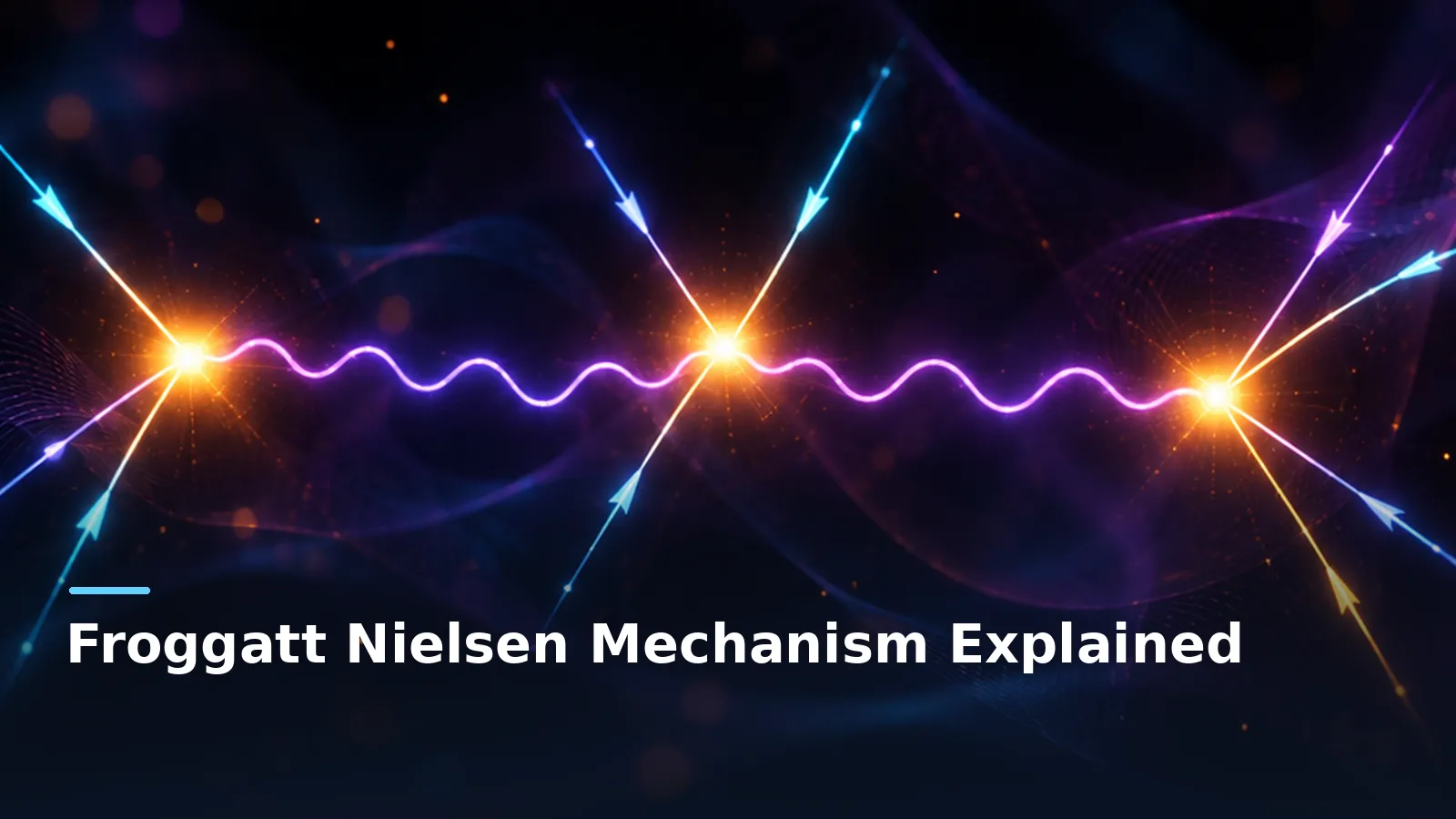
Why heavy particles can matter
A familiar way to realize the mechanism introduces heavy particles that act as intermediaries. The usual light fields interact through these messengers. At energies much lower than the messenger masses, physicists can describe the net effect with an effective interaction, without tracking each virtual step separately.
This is where the scale in the denominator of epsilon can come from. A model that needs several flavon insertions can produce several factors of the small ratio. The low-energy pattern may then preserve a trace of physics at energies beyond the range of a current experiment. The identity and masses of the heavy messengers depend on the particular model.
This distinction helps when reading claims about discovery. Measurements already establish that fermion masses and quark mixing have hierarchical patterns. The existence of a particular flavon, flavor symmetry or messenger sector remains a separate scientific question. It takes a proposed observable consequence and suitable data to test a specific implementation.
Where the explanation is strongest and where it stops
The mechanism is especially useful when the research question concerns structure. It lets physicists turn a table of unrelated numbers into a proposal that can be studied, varied and compared with data. Researchers can see how changing an assignment affects multiple couplings rather than treating every observed value as an isolated puzzle.
Different models can reproduce similar broad patterns. The freedom to choose charges, coefficients and additional fields makes it hard to reconstruct a unique underlying theory from the measured masses alone. A particular proposal may also need to satisfy independent constraints from rare processes or from measurements of how particles change flavor. Those checks matter even if the mass pattern looks promising.
Neutrinos illustrate another limit. Their masses are small and their mixing differs from the quark pattern. Researchers can build flavor models that include them, but the treatment depends on additional assumptions about how neutrinos acquire mass. One cannot infer a universal neutrino prediction merely from the name Froggatt Nielsen. Readers interested in how scientists separate measured results from proposed mechanisms can also explore our guide to bionic technologies and their practical uses, which makes a similar distinction between a general idea and a specific implementation.
Frequently asked questions
Who proposed the Froggatt Nielsen mechanism?
Colin D. Froggatt and Holger Bech Nielsen developed the idea in work published in Nuclear Physics B in 1979. Their paper examined quark mass hierarchies, mixing angles and CP violation.
What does flavor mean in this context?
Flavor labels distinguish related types of fermions, such as the up, charm and top quarks. A flavor symmetry introduces rules that can make those types interact with different strengths.
What is a flavon?
A flavon is a field introduced in some flavor models. When the field acquires a nonzero value in the vacuum, it breaks the flavor symmetry and can enable suppressed interactions.
Has the mechanism been observed directly?
The mass and mixing patterns it seeks to explain are measured. A specific Froggatt Nielsen model remains a hypothesis until independent observations establish the additional physics it predicts.
How does it relate to the Higgs?
The Higgs still participates in generating fermion masses. The Froggatt Nielsen mechanism proposes a reason why the relevant interactions with the Higgs may have very different strengths.
