


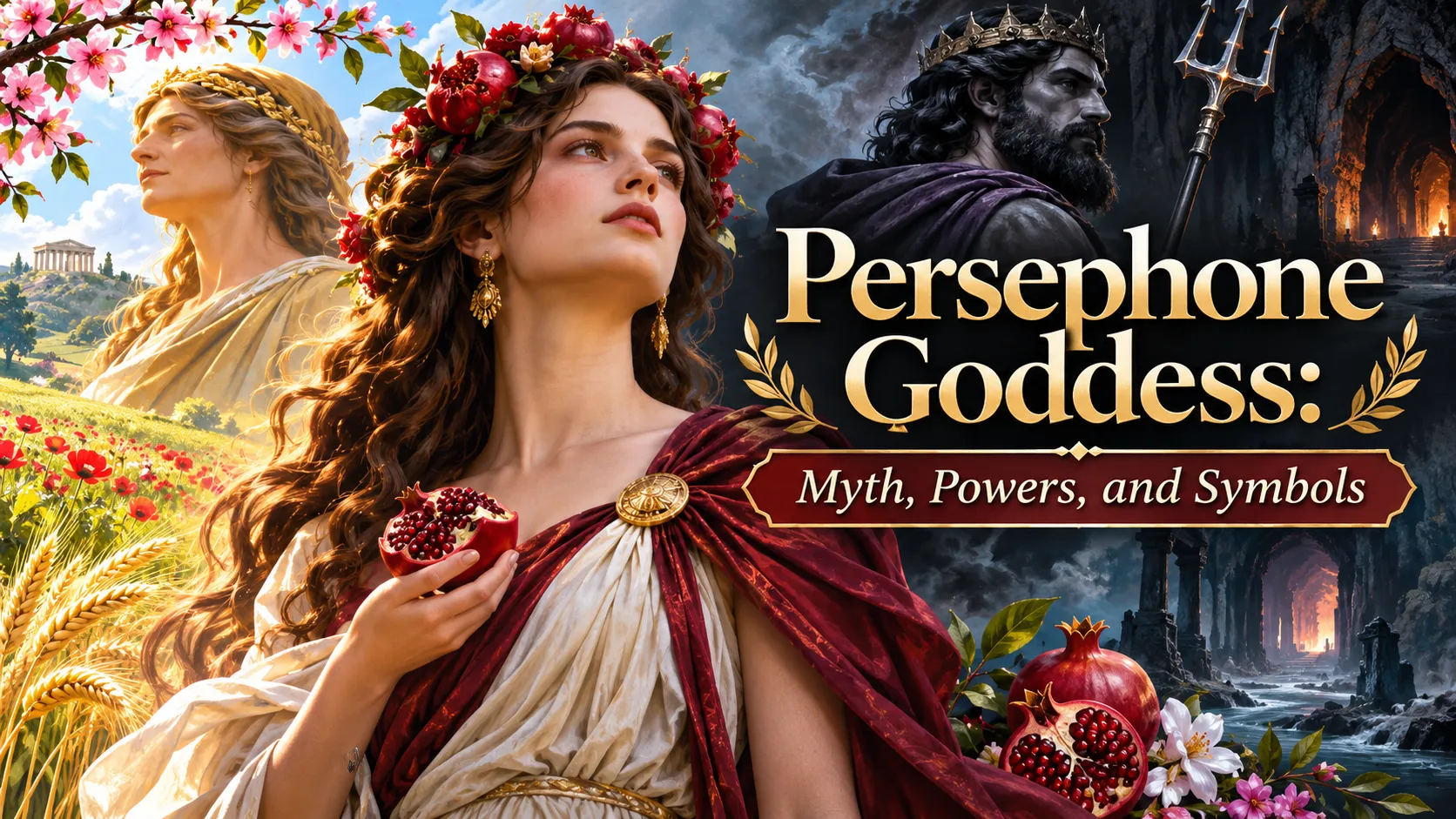
Persephone is the ancient Greek goddess associated with spring, vegetation, and the renewal of life, as well as the powerful queen of the underworld. She is the daughter of Zeus and Demeter and the wife of Hades, the ruler of the realm of the dead. Her mythology connects the changing seasons with themes of separation, reunion, death, and rebirth.
The Persephone Goddess holds a distinctive place in Greek mythology because she belongs to two contrasting worlds. Known as Kore, meaning “Maiden,” she represents youthful growth and agricultural fertility. As queen of the underworld, she also possesses authority over the realm of the dead.
Her best-known story, preserved in the ancient Homeric Hymn to Demeter, explains how her abduction by Hades caused a crisis on Earth and eventually established a recurring cycle of departure and return. This myth influenced Greek religious practices, particularly the Eleusinian Mysteries, and continues to inspire literature, art, and modern interpretations of mythology.
Who Is Persephone in Greek Mythology?
Persephone is a major figure in ancient Greek religion whose identity combines the fertility of the earth with the mysteries of death. She is closely associated with Demeter, the goddess of agriculture, and Hades, the god who rules the underworld.
Unlike deities whose responsibilities are usually described within a single domain, Persephone connects the living world with the world beneath it. Her annual return to her mother became an important mythological explanation for agricultural renewal.
According to the Oxford Classical Dictionary’s scholarly entry on Persephone and Kore, Persephone was worshipped both alongside other deities and through religious traditions specifically associated with her.
Essential Facts About Persephone
| Attribute | Details |
|---|---|
| Greek name | Persephone (Περσεφόνη) |
| Other name | Kore or Core, meaning “Maiden” |
| Roman counterpart | Proserpina, also called Proserpine |
| Father | Zeus, king of the Greek gods |
| Mother | Demeter, goddess of agriculture |
| Husband | Hades, ruler of the underworld |
| Divine roles | Queen of the underworld, associated with vegetation and seasonal renewal |
| Important symbols | Pomegranate, flowers, grain, torches, and royal attributes |
| Major religious center | Eleusis, near Athens, Greece |
| Principal surviving mythological source | Homeric Hymn to Demeter |
Although Persephone is frequently called the goddess of spring, that description captures only part of her identity. Her role as an underworld queen was equally important in ancient Greek religion.
The Myth of Persephone and Hades
The story of Persephone and Hades is among the most influential narratives in Greek mythology. Its most detailed early surviving account appears in the Homeric Hymn to Demeter, an ancient religious poem generally dated to the archaic period of Greek literature.
The myth centers on Persephone’s abduction, Demeter’s grief, and a divine agreement that allows mother and daughter to reunite for part of each year.
How Hades Abducted Persephone
According to the Homeric Hymn to Demeter, Persephone was gathering flowers in a meadow when an extraordinary narcissus attracted her attention. As she reached for the flower, the earth opened and Hades emerged in his chariot.
Hades seized Persephone and carried her into the underworld. Her father, Zeus, had approved the arrangement, but neither Persephone nor Demeter had agreed to it.
The ancient poem presents the abduction as an act of force rather than a voluntary romantic relationship. Persephone cries out during her removal and later describes being taken against her wishes.
This distinction matters because modern retellings sometimes transform the story into a romance. The original narrative, however, emphasizes coercion, maternal grief, and the consequences of divine decisions made without Persephone’s consent.
The account can be examined in the Harvard Center for Hellenic Studies translation of the Homeric Hymn to Demeter.
Demeter’s Search for Her Daughter
When Persephone disappeared, Demeter began searching desperately for her.
Hecate, a goddess associated with crossroads and other supernatural realms, helped Demeter investigate the disappearance. Helios, the sun god who could observe events across the earth, eventually revealed that Hades had taken Persephone with Zeus’s approval.
Demeter’s grief turned into anger. She withdrew from her divine responsibilities and prevented crops from growing, threatening humanity with famine.
The consequences reached beyond the relationship between mother and daughter. Without agriculture, mortals faced starvation, and the gods risked losing the offerings traditionally presented to them.
Demeter’s refusal to restore fertility forced Zeus to intervene. He sent Hermes, the messenger god, to the underworld to arrange Persephone’s return.
Why Did Persephone Eat the Pomegranate Seeds?
Before Persephone departed, Hades secretly gave her pomegranate seed to eat. In the ancient hymn, Persephone explains that he made her consume it against her will.
Because she had eaten food in the underworld, her return to the upper world could not be permanent.
The pomegranate therefore became one of the most recognizable symbols associated with Persephone. In the story, it creates a lasting connection between her life above the earth and her responsibilities below it.
Some modern versions claim that Persephone ate exactly six seeds. However, the Homeric Hymn to Demeter does not establish six as the number. The familiar six-seed explanation should not be treated as a universal feature of ancient Greek mythology.
The Agreement That Allowed Persephone to Return
Zeus ultimately established an arrangement under which Persephone would divide her time between the underworld and her mother.
In the Homeric Hymn to Demeter, Persephone spends one-third of the year in the underworld and two-thirds with Demeter and the other gods.
Other summaries and retellings use different divisions, including half the year. The one-third arrangement is specifically supported by the early hymn and should not be confused with every later version.
Once mother and daughter were reunited, Demeter restored the earth’s fertility. The story established a repeating pattern of absence, reunion, and agricultural regeneration.
The Getty Museum’s examination of Persephone and the ancient underworld also discusses the connection between this myth and Greek religious beliefs about life after death.
Why Is Persephone the Goddess of Spring?
Persephone is associated with spring because her return from the underworld symbolizes the revival of vegetation and the restoration of fertility. Her reunion with Demeter represents the renewal of agricultural life after a period of barrenness.
According to the traditional interpretation, the earth becomes unproductive while Persephone is absent because Demeter mourns her daughter. When Persephone returns, Demeter allows crops and plants to flourish again.
This makes the myth an example of an etiological story, meaning a narrative that explains the origin or cause of a natural or cultural phenomenon.
However, identifying Persephone’s absence strictly with winter is a simplified interpretation.
Ancient Greek agricultural conditions differed from those of regions with extremely cold winters. In Mediterranean climates, grain cultivation depends heavily on seasonal rainfall, and important growing periods may occur during cooler months.
Consequently, scholars interpret Persephone’s seasonal symbolism through agricultural cycles, fertility, and the relationship between life and the earth rather than through a single universal calendar.
The deeper meaning remains consistent: Persephone’s movement between worlds illustrates the recurring relationship between loss and renewal.
Persephone’s Powers as Queen of the Underworld
Persephone is not merely a goddess who temporarily visits the realm of the dead. Ancient Greek literature and art recognize her as its queen, sharing royal authority with Hades.
Her position gives her a significant role in traditions involving death, the afterlife, and the boundaries separating mortals from the divine.
Authority Over the Realm of the Dead
Persephone’s underworld identity appears in early Greek literature, including Homer’s Odyssey.
In Book 11, where Odysseus encounters the spirits of the deceased, Persephone is presented as a formidable divine presence associated with the dead.
The underworld was not simply equivalent to the modern concept of hell. In Greek mythology, it was the realm where the souls of deceased people generally existed, although different traditions described different conditions and destinations within it.
The Metropolitan Museum of Art’s research on death and the afterlife in ancient Greece explains the religious understanding of this realm and the authority attributed to Hades and Persephone.
Influence Over Life, Death, and Renewal
Persephone’s connection with both the underworld and agricultural fertility made her particularly important in religious traditions concerned with transitions.
She represented the relationship between life emerging from the earth and the eventual return of living beings to it.
Her powers were understood differently across myths and cult traditions. Ancient sources do not provide a standardized list of supernatural abilities comparable to those found in modern fantasy stories.
Her central divine responsibilities can be understood through three major associations: authority in the underworld, participation in the earth’s fertility, and religious significance in beliefs about the afterlife.
Persephone and the Story of Orpheus
Another important myth involving Persephone concerns Orpheus, the legendary musician who descended into the underworld to recover his deceased wife, Eurydice.
Orpheus used his extraordinary musical abilities to appeal to the rulers of the dead.
Hades and Persephone agreed to allow Eurydice to return under a condition: Orpheus could not look back at her before completing their journey to the upper world.
He failed to obey the condition and lost Eurydice again.
The story illustrates Persephone’s position as an underworld authority involved in decisions about the living and the dead. It is discussed in the Getty Museum’s exhibition materials on Orpheus and ancient conceptions of the afterlife.
Persephone’s Symbols and Their Meanings
Persephone’s symbols reflect her contrasting associations with fertility, springtime, royalty, and the underworld. Some appear directly in ancient myths, while others are particularly prominent in religious art.
The Pomegranate
The pomegranate is Persephone’s most famous symbol.
Its importance comes from the food she consumed before leaving Hades’ realm. The fruit represents the binding connection between her two worlds.
Modern interpretations often associate the pomegranate’s many seeds with fertility and abundance, although these interpretations should be distinguished from the specific details of ancient texts.
Flowers and the Narcissus
Flowers represent Persephone’s youthful identity as Kore and her association with vegetation.
The narcissus is particularly significant because it appears in the story of her abduction. Its beauty attracts Persephone immediately before the earth opens beneath her.
The flower therefore has a dual meaning in the narrative, connecting natural beauty with the sudden loss of freedom.
Grain and Agricultural Abundance
Wheat and other grain imagery connect Persephone with her mother, Demeter.
These symbols represent cultivated land, food production, and the agricultural prosperity upon which ancient communities depended.
Together, Demeter and Persephone were central figures in religious traditions celebrating fertility and the continuation of life.
Torches
Torches appear in ancient religious imagery connected with Demeter, Persephone, and Hecate.
They are associated with the search for Persephone, movement through darkness, and ceremonial activities connected to her worship.
Ancient artworks frequently show these goddesses holding torches or participating in scenes related to Persephone’s return.
Crowns and Royal Attributes
As queen of the underworld, Persephone also appears with attributes of divine status and royalty.
Ancient representations sometimes show her enthroned or standing beside Hades, emphasizing her elevated position within the underworld.
These images remind viewers that Persephone is not exclusively a figure of springtime innocence but also a powerful goddess.
Persephone and the Eleusinian Mysteries
The Eleusinian Mysteries were among the most important religious traditions associated with Demeter and Persephone in ancient Greece.
Held at Eleusis, near Athens, these initiation ceremonies were connected with agricultural fertility, divine revelation, and hopes concerning existence after death.
What Were the Eleusinian Mysteries?
The Eleusinian Mysteries were religious rites in which initiates participated in ceremonies honoring Demeter and Persephone.
According to the Homeric Hymn to Demeter, Demeter established sacred rites at Eleusis following the events surrounding her daughter’s disappearance.
The ceremonies became an important institution in Greek religious life and continued for centuries.
Participants traveled from Athens to Eleusis in ceremonial processions. The rites themselves were secret, and initiates were expected not to reveal their contents.
Because this secrecy was maintained, historians cannot reconstruct every stage of the ceremonies with certainty.
The Metropolitan Museum of Art’s study of mystery cults explains how the Eleusinian traditions connected the myth of Demeter and Persephone with agricultural cycles and religious initiation.
Why Was Persephone Important to These Rituals?
Persephone’s disappearance and return provided a powerful religious image of movement between darkness and renewed life.
For participants, the myth offered more than an explanation for seasonal agricultural changes. It was also connected with the hope that death might not represent the complete end of meaningful existence.
The Eleusinian Mysteries were associated with expectations of a more favorable afterlife for initiates, although surviving evidence does not allow every belief or ceremony to be described precisely.
Persephone’s dual identity made her especially suitable for this religious role.
She could represent both the mysterious realm of the dead and the possibility of renewal.
Persephone in Ancient Greek Art
Ancient sculptures, painted pottery, and religious reliefs provide valuable evidence of how Persephone was understood and represented.
Artists depicted her in scenes of abduction, reunion with Demeter, religious ceremonies, and royal appearances in the underworld.
The Great Eleusinian Relief
One significant example is the Great Eleusinian Relief, originally associated with the sanctuary at Eleusis.
The composition depicts Demeter and Persephone alongside a youthful figure generally identified as Triptolemos, a mythological hero connected with the teaching of agriculture.
The Metropolitan Museum of Art preserves Roman marble fragments from a copy of this ancient Greek composition.
The museum identifies Persephone on the right side of the scene and discusses the artwork’s connection to the Eleusinian sanctuary.
The surviving work provides important evidence of the relationship between the two goddesses and ancient agricultural religion.
See the Metropolitan Museum of Art’s Great Eleusinian Relief collection record.
The Return of Persephone on a Greek Vase
Another important representation appears on an Attic red-figure bell-krater dated to approximately 440 BCE.
The artwork shows Persephone ascending from the underworld, accompanied by Hermes and Hecate, while Demeter awaits her return.
The scene emphasizes reunion and the restoration of life rather than the original abduction.
This object is preserved in the Metropolitan Museum of Art’s collection of Greek pottery.
Together, these artworks demonstrate how Persephone’s mythology influenced both religious imagery and the visual representation of seasonal renewal.
Other Important Myths About Persephone
Although her abduction and return are her most familiar stories, Persephone appears in several other ancient mythological traditions.
Persephone, Aphrodite, and Adonis
In a tradition preserved by the mythological writer commonly called Apollodorus, Aphrodite entrusted the young Adonis to Persephone.
Persephone became attached to Adonis and refused to return him.
The disagreement eventually required divine intervention, and an arrangement was established dividing Adonis’s time between the goddesses and a period of independence.
This account reflects another mythological pattern involving relationships between the living world, the underworld, and cycles of return.
It also demonstrates that Greek mythology contains multiple narratives in which Persephone exercises personal influence rather than appearing solely as the subject of Hades’ actions.
The story is preserved in Apollodorus’s Library, Book 3.
Was Persephone the Mother of Dionysus?
In the most familiar Greek tradition, Dionysus is the son of Zeus and Semele.
However, some religious traditions associated with Orphic mythology identify Persephone as the mother of a form of Dionysus.
These accounts involve the god’s destruction and subsequent restoration, themes that connect with death, divine renewal, and religious purification.
It would be inaccurate to present this alternative genealogy as the single accepted Greek account.
Ancient mythology developed through different literary, regional, and religious traditions, and these traditions did not always agree.
The Getty Museum discusses this alternative narrative in its research on Orphic beliefs and the underworld.
Persephone vs. Demeter: What Is the Difference?
Persephone and Demeter are closely connected, but their mythological identities are not identical.
Demeter is primarily the goddess of agriculture, cultivated grain, and the earth’s fertility. Persephone shares associations with vegetation and renewal but also holds an independent position as queen of the underworld.
| Feature | Persephone | Demeter |
|---|---|---|
| Main identity | Queen of the underworld and goddess associated with seasonal renewal | Goddess of agriculture and cultivated grain |
| Family relationship | Daughter | Mother |
| Connection with seasons | Her departure and return structure the seasonal myth | Her grief and reconciliation affect the earth’s fertility |
| Underworld authority | Rules alongside Hades | Not generally represented as an underworld ruler |
| Religious importance | Central to the Eleusinian Mysteries | Central to the Eleusinian Mysteries |
Their relationship is essential to understanding the myth.
Demeter’s refusal to allow crops to grow shows the scale of her divine power, while Persephone’s eventual return establishes the recurring balance between the two realms.
Persephone in Roman Mythology
In Roman mythology, Persephone was identified with Proserpina, also known as Proserpine.
Her mother Demeter was identified with Ceres, while Hades was associated with Pluto, the Roman ruler of the underworld.
Roman poets adapted the Greek story, sometimes emphasizing different dramatic and emotional elements.
One especially influential retelling appears in Ovid’s Metamorphoses, where the abduction of Proserpina becomes part of a larger collection of mythological transformations.
Although the Greek and Roman versions share major characters and themes, details can differ according to the author, period, and religious setting.
For historical accuracy, it is important to identify which version is being discussed rather than combining every tradition into one supposedly definitive account.
What Does Persephone Symbolize Today?
Persephone remains an important figure in modern literature, art, and interpretations of mythology.
Her story is frequently used to explore grief, personal transformation, separation, identity, and the relationship between life and death.
Modern writers sometimes interpret her movement between the upper world and the underworld as a metaphor for psychological change or the transition from youth to adulthood.
Other interpretations focus on Demeter’s determination to recover her daughter or on Persephone’s position as a powerful female ruler.
These readings can be meaningful, but they are modern interpretations rather than automatically established beliefs of the ancient Greeks.
The Difference Between Ancient Myth and Modern Romance
Contemporary fictional adaptations sometimes describe Persephone and Hades as romantic partners whose relationship develops through mutual attraction.
The earliest major surviving narrative presents a different beginning.
In the Homeric Hymn to Demeter, Persephone is abducted, and Zeus approves the arrangement without her consent. Her grief and unwillingness are important parts of the story.
Modern authors are free to reinterpret mythology, but those adaptations should not be mistaken for direct descriptions of the ancient source material.
A scholarly discussion of these narrative elements appears in the Cambridge journal Greece & Rome, in the article Demeter Moves in Mysterious Ways?.
Frequently Asked Questions About Persephone Goddess
1. What is Persephone the goddess of?
Persephone is the Greek goddess associated with vegetation, seasonal renewal, and the underworld. She is best known as the daughter of Demeter and Zeus and the queen who rules alongside Hades.
2. Is Persephone the goddess of spring or death?
Persephone is associated with both seasonal growth and the realm of the dead. Calling her the goddess of spring describes her connection with vegetation, while her role as queen of the underworld reflects her authority in Greek beliefs about death and the afterlife.
3. Did Persephone willingly marry Hades?
In the Homeric Hymn to Demeter, Persephone does not willingly participate in her abduction. Hades takes her by force with Zeus’s approval, and the poem clearly describes her distress. Some later literary and modern adaptations portray the relationship differently.
4. How many months does Persephone spend in the underworld?
The Homeric Hymn to Demeter states that Persephone spends one-third of the year in the underworld, equivalent to approximately four months in a twelve-month year. Other retellings describe a different division, sometimes assigning her six months in each realm.
5. What is Persephone’s most important symbol?
The pomegranate is Persephone’s most recognizable symbol because of its role in the myth explaining her recurring return to the underworld. Flowers, grain, torches, and royal imagery are also associated with her in ancient mythology and art.
6. What is Persephone’s Roman name?
Persephone’s Roman counterpart is Proserpina, also called Proserpine. Roman mythology associates her with Pluto, the ruler of the underworld, and Ceres, the goddess of agriculture.
Also Read: Dinares Gurus: Iraqi Dinar News, RV Updates and Facts (2026)

1 Comment
Pingback: Engıne Repaır: Warning Signs, Costs and Solutions