


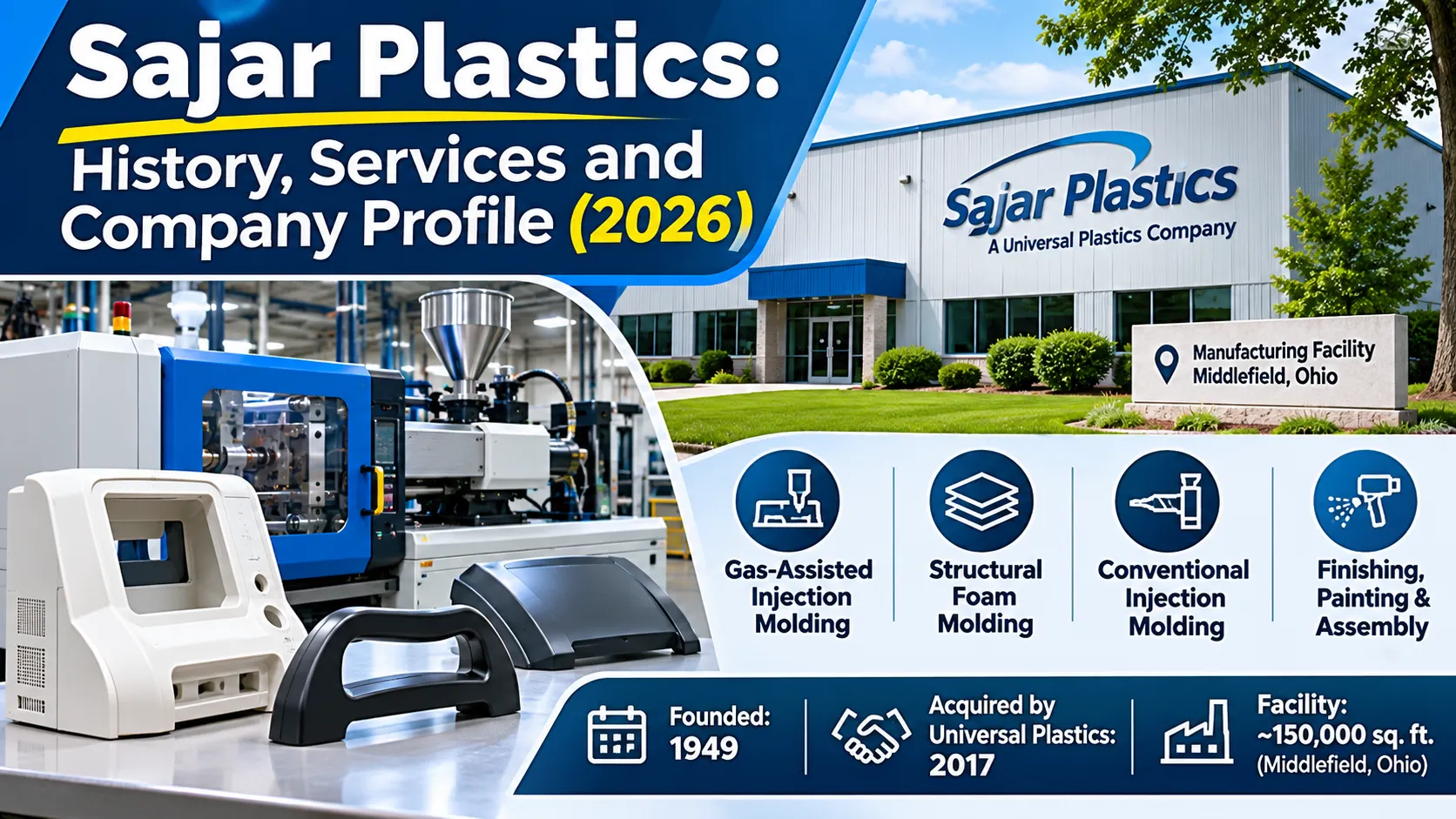
Sajar Plastics is an American custom plastics manufacturer based in Middlefield, Ohio, specializing in gas-assisted injection molding, structural foam molding, and large, complex plastic components. Founded in 1949, the company was acquired by Universal Plastics in 2017, and its manufacturing operation continues under the Universal Plastics name in 2026.
Known for its early involvement in gas-assisted injection molding technology, Sajar Plastics has served original equipment manufacturers (OEMs) across the medical, laboratory, industrial, and retail sectors. Its expertise focuses on producing durable plastic components with complex shapes, controlled dimensions, and attractive surface finishes.
Although the Sajar name appears in older business directories and manufacturing publications, the company has undergone important ownership and branding changes. Understanding those developments helps explain its current business structure, manufacturing capabilities, and position in the American plastics industry.
What Is Sajar Plastics?
Sajar Plastics is a custom injection molding business with decades of experience manufacturing large plastic parts for commercial and industrial customers. Rather than producing ordinary consumer packaging or selling finished household products, the business primarily manufactures specialized components designed for other companies’ equipment and products.
Its manufacturing expertise includes standard injection molding, gas-assisted injection molding, and structural foam molding. These processes allow manufacturers to produce components with different structural, dimensional, and surface-finish requirements.
According to Universal Plastics’ official company information, the Middlefield operation serves customers in medical equipment, laboratory diagnostics, manufacturing, and retail dispensing applications.
Sajar Plastics Company Overview
| Category | Verified information |
|---|---|
| Company name | Sajar Plastics |
| Founded | 1949 |
| Industry | Plastics manufacturing |
| Original location | Middlefield, Ohio, United States |
| Current business affiliation | Universal Plastics |
| Acquisition | 2017 |
| Principal specialization | Gas-assisted injection molding |
| Additional capabilities | Standard injection molding, structural foam molding, finishing, and assembly |
| Manufacturing facility | Approximately 150,000 square feet |
| Listed molding equipment | 17 machines, ranging from 85 to 1,500 tons |
| Primary customers | Industrial and commercial OEMs |
| Current operating identity | Universal Plastics Middlefield |
The manufacturing figures come from the company’s official facilities directory. They describe published capabilities rather than independently audited production capacity.
The History of Sajar Plastics
Founding and Early Development in 1949
Sajar Plastics was established in Middlefield, Ohio, in 1949. Its history spans more than seven decades of changes in plastic materials, manufacturing equipment, product design, and industrial production methods.
The company developed its business around molded plastic components. As customer requirements became more sophisticated, its manufacturing activities increasingly emphasized larger parts, specialized processing, and demanding cosmetic specifications.
This focus helped distinguish Sajar from general-purpose molding operations. Producing a large equipment enclosure, for example, requires careful control of material flow, cooling, structural support, and dimensional stability.
The company’s longstanding specialization in complex molded parts eventually became a central part of its commercial identity.
Pioneering Gas-Assisted Injection Molding
One of Sajar Plastics’ most significant historical contributions was its involvement in developing gas-assisted injection molding during the early 1980s.
According to Universal Plastics’ Middlefield facility profile, Sajar was among three companies involved in the early development of this manufacturing technology.
Gas-assisted molding became particularly valuable for producing large plastic components with challenging shapes and high-quality visible surfaces.
The company reports having commercialized more than 500 different gas-assisted molded components. This is a company-reported historical figure, not a separately verified count of products currently in production.
Private Equity Ownership and the 2017 Acquisition
Before joining Universal Plastics, Sajar was owned by Pittsburgh-based private equity firm Main Street Capital Holdings, which acquired the business in 2008.
In June 2017, Universal Plastics acquired Sajar, with the transaction publicly announced on July 6, 2017. The purchase expanded Universal’s capabilities beyond heavy-gauge thermoforming into specialized large-part injection molding.
According to MBS Advisors, which advised Sajar on the transaction, the acquisition was intended to create complementary manufacturing capabilities for industrial customers.
The purchase price was not publicly disclosed.
Larry Nowak, who was serving as Sajar’s president and CEO, was expected to continue leading the Middlefield operation following the acquisition. That historical arrangement should not be interpreted as confirmation of the company’s management structure in 2026.
The 2020 Universal Plastics Rebranding
A second important development occurred on January 27, 2020.
Universal Plastics announced that its various manufacturing businesses, including Sajar Plastics, Mayfield Plastics, and Premium Plastic Solutions, would operate under the consolidated Universal Plastics name.
The change was intended to simplify the group’s identity and make its manufacturing services easier for customers to access.
The 2020 company announcement established that the businesses were being integrated under one brand.
Consequently, Sajar Plastics is best understood today as a historical business name associated with Universal Plastics’ Middlefield injection molding operation, rather than an entirely separate manufacturing brand.
What Does Sajar Plastics Manufacture?
Sajar Plastics specializes in custom industrial components that must meet specific engineering requirements. These products often need to be strong, dimensionally consistent, and visually suitable for use on commercial equipment.
Examples of the types of components associated with its manufacturing expertise include:
- Medical and laboratory equipment housings.
- Large plastic doors, covers, and protective panels.
- Industrial equipment enclosures and cabinets.
- Retail register and dispensing-machine components.
- Plastic bezels, frames, handles, and structural parts.
- Custom assemblies incorporating multiple molded components.
These examples represent manufacturing applications and capabilities, not a catalog of products available for retail purchase.
The company works primarily with OEM customers that provide product requirements, engineering drawings, quality specifications, and production-volume expectations.
Medical and Laboratory Equipment Components
Medical and diagnostic equipment frequently requires plastic housings that protect internal components while supporting cleaning, usability, and reliable assembly.
Sajar’s manufacturing expertise is relevant to equipment covers, instrument panels, laboratory enclosures, and related components.
However, manufacturing a component for medical equipment does not automatically mean that every product is an FDA-approved medical device. Regulatory requirements depend on the finished device, its intended use, and the responsibilities of the companies involved.
Industrial and Commercial Equipment
Industrial equipment manufacturers often require large plastic components with structural support, mounting points, and accurately positioned openings.
Gas-assisted injection molding can help create integrated features while reducing certain surface defects associated with conventional molding.
The result can be a component that combines several structural and cosmetic requirements within one molded design.
Sajar Plastics Manufacturing Technologies
The company’s manufacturing reputation rests largely on three injection molding processes. Each serves different product requirements and involves different cost, tooling, and design considerations.
1. Gas-Assisted Injection Molding
Gas-assisted injection molding introduces pressurized gas, commonly nitrogen, into a mold during the plastic molding process.
The gas can displace molten plastic inside selected thicker regions, creating hollow sections while helping press the material against the mold surface.
This technique may reduce material consumption, improve dimensional stability, and limit visible sink marks. Sink marks are small surface depressions that can appear when plastic cools unevenly.
Gas-assisted molding is particularly useful for large handles, equipment covers, frames, doors, and components containing substantial internal ribs.
Universal Plastics describes both internal and external gas-assisted molding methods in its technical guide to gas-assisted injection molding.
Internal gas-assisted molding uses gas channels within the plastic component to help distribute pressure and form hollow sections.
External gas-assisted molding introduces gas between a mold surface and the plastic part to help maintain pressure against the opposite visible surface.
These techniques require appropriate part geometry, tooling, process control, and material selection. Their advantages are not guaranteed for every plastic product.
2. Structural Foam Molding
Structural foam molding produces plastic components using a molding process that creates a cellular structure within the material.
A blowing agent helps generate small gas bubbles within the plastic, allowing manufacturers to produce substantial, relatively lightweight structural components.
The process is particularly useful for large parts that require rigidity and structural performance.
However, structural foam parts may need additional finishing when they are intended for highly visible surfaces.
According to Universal Plastics’ structural foam manufacturing guide, the process is especially suitable for large structural parts where surface appearance may be less important than strength and functionality.
3. Conventional Injection Molding
Traditional injection molding involves injecting molten plastic into a shaped mold under pressure. Once the material cools sufficiently, the mold opens and the component is removed.
It is a widely used manufacturing process for parts ranging from small technical components to larger equipment panels.
At the Middlefield facility, conventional injection molding complements the company’s more specialized gas-assisted and structural foam capabilities.
The choice between these processes depends on component geometry, material requirements, cosmetic expectations, production quantity, and overall manufacturing cost.
Manufacturing Facility and Production Capabilities
The original Sajar operation is located at:
15285 South State Avenue, Middlefield, Ohio 44062, United States.
Universal Plastics currently identifies this location as its Middlefield manufacturing facility.
According to the company’s published specifications, the facility includes approximately 150,000 square feet of manufacturing space and 17 molding machines.
The machines have listed clamping capacities ranging from 85 to 1,500 tons. Clamping force is the pressure used to hold the mold closed during injection.
The company also reports capabilities for manufacturing parts with dimensions reaching approximately 70 by 80 inches, depending on product requirements.
These specifications demonstrate an emphasis on large-part manufacturing, although maximum machine capacity alone does not establish whether a particular product can be manufactured successfully.
Finishing, Painting, and Assembly
Manufacturing a plastic component often involves more than molding the original shape.
The Middlefield operation also advertises in-house painting, secondary operations, and assembly services.
These services can help customers reduce the number of suppliers involved in finishing a product.
For example, an equipment manufacturer may require a molded housing that must also be painted, fitted with additional components, and prepared for final assembly.
Combining several production stages within one manufacturing operation can simplify coordination, although actual cost and delivery advantages depend on the project.
Who Owns Sajar Plastics in 2026?
Sajar Plastics was acquired by Universal Plastics in 2017 and remains associated with Universal Plastics’ Middlefield manufacturing operation in 2026.
Universal Plastics Group developed through a series of manufacturing acquisitions intended to expand its range of plastics-processing technologies.
The organization has offered capabilities across multiple manufacturing locations, including thermoforming, injection molding, and blow molding.
These processes serve different purposes.
Thermoforming shapes heated plastic sheets over tooling, while injection molding fills a mold cavity with molten plastic. Blow molding is commonly used to produce hollow plastic products.
Importantly, not every Universal Plastics manufacturing site provides every process. The Middlefield operation specializes in injection molding, while other locations provide additional capabilities.
The company’s consolidated business structure allows customers to investigate several manufacturing options through one broader organization.
Publicly available records do not establish a separate, independently reported 2026 valuation for the historic Sajar operation.
Is Sajar Plastics Still in Business in 2026?
Yes. Available company information and Ohio government records support the conclusion that the former Sajar Plastics operation remains active as Universal Plastics Middlefield in 2026.
Universal Plastics continues to list the Middlefield factory, its injection molding capabilities, address, and telephone number on its official website.
An additional source of recent evidence comes from the Ohio Bureau of Workers’ Compensation.
The June 2026 Workplace Safety Grant
The Ohio Bureau of Workers’ Compensation’s fiscal-year 2026 safety grants report identifies Universal Plastics – Sajar Molding Services Inc. as an approved recipient of a $40,000 Safety Intervention Grant.
The report gives an approval letter date of June 3, 2026.
The safety intervention program provides financial assistance for equipment intended to reduce or eliminate workplace injuries and illnesses associated with particular operations.
This official record offers recent, independent evidence of business activity associated with the Sajar name.
However, the published grant summary does not specify the equipment involved, confirm its installation, or provide updated employee numbers.
Taken together, the government record and the company’s current facility listing provide stronger evidence of continued operation than older business-directory entries alone.
Quality Standards and Manufacturing Reliability
Quality management is especially important for companies producing industrial components that must meet customer specifications.
Universal Plastics states that it operates under the ISO 9001:2015 quality management standard and provides links to certification documents on its website.
ISO 9001 is an internationally recognized standard concerned with quality management systems, documentation, process control, corrective actions, and continuous improvement.
The company’s certifications and affiliations page identifies Middlefield among its injection molding certification locations.
However, a previously published Middlefield certificate expired in January 2022. Buyers requiring independently verified current certification should request an updated, valid certificate directly from the company rather than relying on the older document.
For regulated or quality-sensitive applications, procurement teams should also confirm applicable testing, material traceability, inspection procedures, and customer-specific requirements.
Sajar Plastics Compared With Other Manufacturing Processes
The value of a specialized molding operation depends on whether its manufacturing capabilities match the customer’s product.
| Manufacturing process | Main characteristics | Suitable applications |
|---|---|---|
| Conventional injection molding | Detailed molded geometry and repeatable production | Equipment panels, covers, technical components |
| Gas-assisted injection molding | Hollow internal sections, potential weight reduction, improved visible surfaces | Large handles, doors, enclosures, complex housings |
| Structural foam molding | Cellular structure and large structural components | Industrial cabinets, supports, equipment structures |
| Thermoforming | Shapes heated plastic sheets with comparatively accessible tooling options | Large covers, trays, panels, lower-volume products |
| Blow molding | Produces hollow plastic shapes | Containers, tanks, hollow equipment components |
No single process is universally superior.
Injection molding often requires significant tooling investment, making production volume an important consideration. Thermoforming may be more economical for certain lower-volume or large-panel applications.
Gas-assisted molding can offer benefits for complex parts, but it also introduces design and tooling considerations.
An experienced manufacturing supplier should evaluate the specific part rather than recommend a process solely because it is available.
Advantages and Limitations of Sajar Plastics
Manufacturing Strengths
Sajar’s documented history and production capabilities suggest several potential advantages for industrial customers.
Its longstanding involvement in gas-assisted molding indicates specialized experience with large, challenging plastic components.
The Middlefield facility also combines multiple molding processes with painting, finishing, and assembly services.
Its location in northeastern Ohio provides a practical manufacturing base for customers in the Midwest and other United States markets.
In addition, its integration into Universal Plastics gives customers access to a broader group of plastics manufacturing capabilities.
Potential Limitations
The company’s strengths do not make it suitable for every manufacturing project.
Large custom injection molding projects may require substantial upfront tooling expenditures. Complex parts also require engineering evaluation, prototypes, process development, and testing.
For very small production quantities, alternative methods may prove more economical.
Other limitations involve publicly available business information. Current product pricing, customer-specific lead times, annual revenue, profitability, and detailed staffing numbers are not comprehensively disclosed.
Consequently, prospective buyers should request current technical and commercial information rather than assume that historical figures describe the business today.
How to Contact Sajar Plastics
Customers searching for Sajar Plastics should use Universal Plastics’ current contact information for its Middlefield operation.
Manufacturing location: Universal Plastics Middlefield
Address: 15285 South State Avenue, Middlefield, Ohio 44062, USA
Telephone: +1 440-632-5203
Website: Universal Plastics official website
Facility information: Middlefield injection molding services
The company’s website provides information about manufacturing processes, project requirements, and quotation inquiries.
Before requesting a quote, a business should ideally prepare technical drawings, anticipated production quantities, preferred plastic materials, cosmetic requirements, and any applicable regulatory or quality specifications.
Providing these details makes it easier for the manufacturer to determine whether the project is technically and commercially feasible.
Frequently Asked Questions About Sajar Plastics
1. What is Sajar Plastics known for?
Sajar Plastics is best known for manufacturing large, complex plastic components using gas-assisted injection molding. The company was involved in the early development of this technology and has served medical, laboratory, retail, and industrial equipment manufacturers.
2. When was Sajar Plastics founded?
Sajar Plastics was founded in 1949 in Middlefield, Ohio. Its manufacturing history extends across more than 75 years of developments in plastics processing.
3. Who owns Sajar Plastics today?
Universal Plastics acquired Sajar Plastics in 2017. The former Sajar manufacturing operation now operates within the Universal Plastics business under the Middlefield facility identity.
4. Is Sajar Plastics still operating in 2026?
Available evidence supports its continued operation. Universal Plastics currently lists the Middlefield manufacturing facility, and an official Ohio report records a $40,000 workplace safety grant approved for Universal Plastics – Sajar Molding Services Inc. on June 3, 2026.
5. What products does Sajar Plastics manufacture?
The business specializes in custom plastic components such as medical equipment housings, industrial enclosures, covers, cabinets, handles, and other complex molded parts. These products are primarily manufactured for commercial and industrial customers rather than sold directly to consumers.
6. Does Sajar Plastics offer gas-assisted injection molding?
Yes. Gas-assisted injection molding is one of the Middlefield facility’s principal specialties. The process uses pressurized gas during molding to help form selected internal structures and improve certain manufacturing characteristics.
Also Read: Zelanski: Meaning, Origin, and Zelenskyy Connection

1 Comment
Pingback: Glomvi.cc: Features, Safety, and Streaming Risks (2026)